


Intel has begun rolling out its first Meteor Lake architecture Core Ultra processor in laptops, heralding a new AI PC era.
Intel claims three major selling points for the Core Ultra:
- Reduced power consumption through Intel 4 technology
- Significant improvement in graphics performance
- Artificial Intelligence
The Core Ultra processor is named without the previous “i,” directly using “Ultra.” This includes the high-performance “H” series and the low-power “U” series.
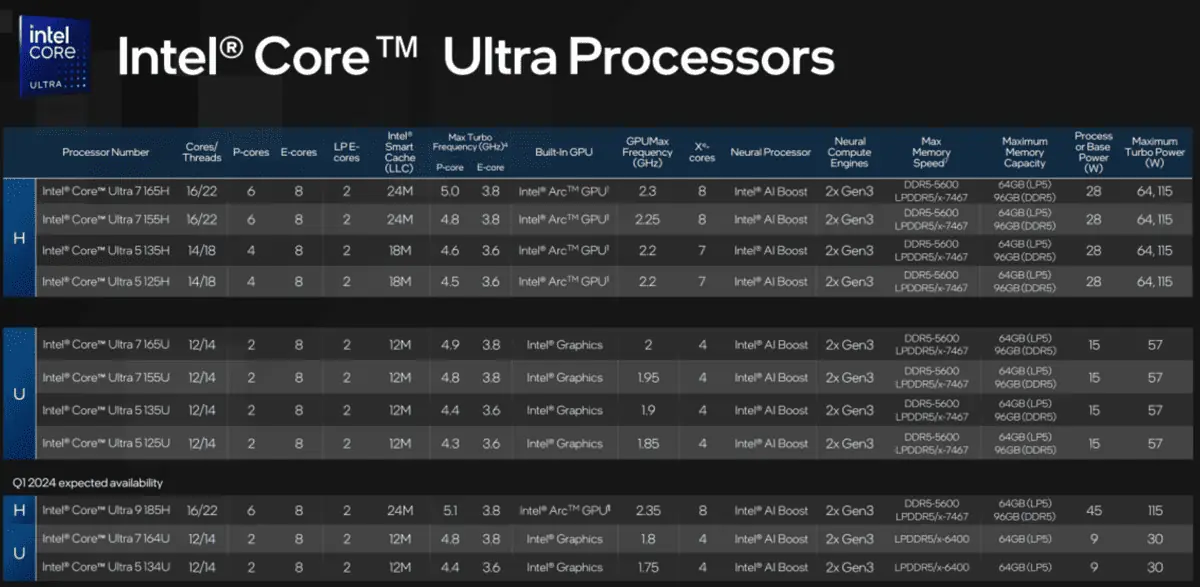
In both the H series and U series chips, Core Ultra features two low-power E cores (LP E cores) and an NPU. Only the P core utilizes hyper-threading, and both P and E cores have their own Turbo Boost acceleration.
The new H series operates at 28W power consumption. In Intel’s 13th generation, the 28W processors were named the P series. With the new Core Ultra, Intel has discontinued the P series.
Intel also plans to introduce other products in the Core Ultra series, including its first Core Ultra 9 chip, later in the first quarter.
01
How low is the power consumption of Core Ultra?
Intel claims that compared to the Ryzen 7 7840U, there will be 79% power savings in idle Windows state; power consumption during Netflix streaming will decrease by 48%. Compared to the Core i7-1370P, power consumption will decrease by 25%.
02
How fast is Core Ultra?
Intel claims that laptops equipped with the Intel Core Ultra 7 165H will exhibit a 12% higher single-threaded CPU performance compared to the AMD 7840U.
Intel asserts that its Core Ultra performs faster in both single-threaded and multi-threaded applications compared to its competitors. In real-world scenarios, the overall performance of the Core Ultra chip will surpass the Ryzen 7 7840U.
Intel also emphasizes that the GPU performance is what truly enhances the Core Ultra. The Ultra 7 165H outperforms the i7-1370P by 100% in the game Baldur’s Gate 3 (1080p resolution, medium settings), and it delivers performance in ultra-thin laptops roughly equivalent to the AMD Ryzen 7 7840U.
Intel states that by employing Intel’s XeSS (Xe Super Sampling) technology, frame rates can nearly triple in the 13th generation. XeSS utilizes Intel’s AI inference instructions to provide graphical enhancements.
03
How powerful is Core Ultra’s AI?
The Meteor Lake architecture, supporting the Core Ultra chip, marks Intel’s first architecture integrating a Neural Processing Unit (NPU). This architecture collaborates with the GPU and CPU to execute AI computations, claiming a capability of 340 trillion operations per second (34 TOPS) by Intel. This falls somewhat behind the Snapdragon X Elite by Qualcomm (75 TOPS) and AMD’s (39 TOPS) Ryzen 8040 series Hawk Point NPU.
AI PCs run AI locally on the PC rather than in the cloud. By 2023, this implies that PC buyers can opt to run dedicated AI applications on local hardware.
Intel also claims that the NPU can be used to enhance performance (showing a 1.7x improvement compared to i7-1370P in Solid Diffusion) and for power savings (a 38% reduction in power consumption during Zoom usage). It has demonstrated performance data across various applications.


Related:
- When Choosing a Gaming Computer with Intel i5 Processor?
- NPU vs. CPU, GPU: Unveiling Key Differences
- Intel 300 Series Review: Top Dual-Core Performance!
- Core i5 10600K Performance Review: Upgrade Worth It?
- Fix Unstable Gaming on 13th & 14th Gen Core CPUs by MSI
- Coming Soon: Intel 15th & 16th Gen Core CPUs!
- Breakthrough: China Makes Ultra-Pure 5N Iron